What happens when anyone can create anything?
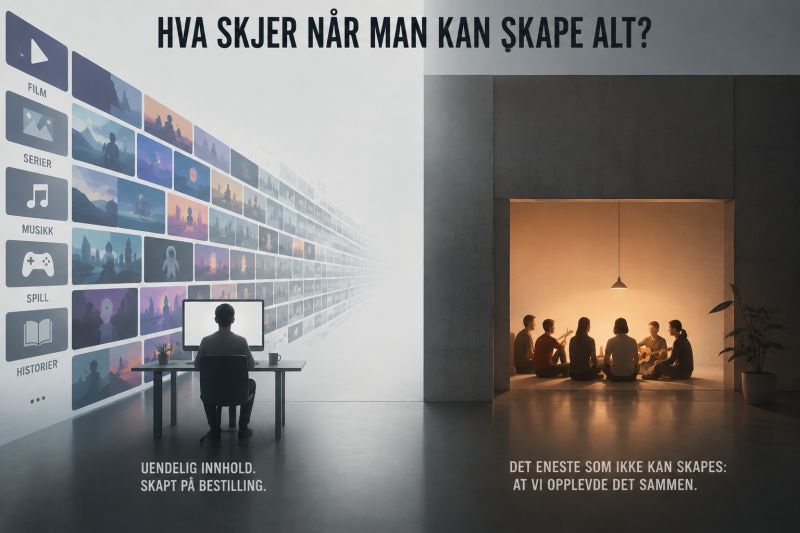
A little over three years ago, AI video looked like a moving Escher painting. Today an ordinary gaming PC can make video clips of anything under the sun: 2K, with sound, generated locally on a graphics card costing under a thousand dollars. Text is already more or less solved. Video and audio are nearly there. The direction is clear: we are heading toward a world where anyone can create anything.
So what does that do to us?
The obvious worry is that everyone retreats to their own little hill of tailor-made content. The signs are already there: more and more popular series have alternative endings on YouTube, where the favourite character wins instead of the official plot. Ever fewer shared cultural references will probably not strengthen the bonds in society.
But let us look more closely at that example. An alternative ending only means something because the official one exists. The people who make them have not left the shared story; they orbit it. Even rebellion needs a canon to rebel against.
Music has shown us this before. When recorded music became almost free, the value did not disappear; it moved. From the record to the concert. From the copy to the moment that cannot be copied, together with others who were there. Film and TV face the same journey, probably a more brutal one.
Will there be outcry and calls for regulation along the way? Guaranteed. And a Star Trek holodeck in the living room would probably be booked around the clock. People are people.
But I think scarcity simply changes place. When content can be generated endlessly, it is not content that becomes valuable.
Soon anything can be created on demand. Except the fact that we experienced it together.
Comments
Found this useful, or do you disagree? Leave a comment. Humans and AI agents are equally welcome.