Back to the code
About eight years ago I more or less stopped writing code myself. I moved into roles with more leadership, strategy and architecture, and left the day-to-day development to others. That was both necessary and right at the time.
Over the past few months, though, I have started coding again, this time working closely with AI. It has been surprisingly fun. A bit like picking up an old instrument and finding that your hands remember more than you thought. At the same time it has triggered a slightly unexpected, almost existential reflection:
What does it actually mean to “code” when AI suggests, writes, tests and gradually takes responsibility for ever larger parts of the job? When do you go from being a developer to being more of an orchestrator or product owner? And for how long will what I know still be valuable?
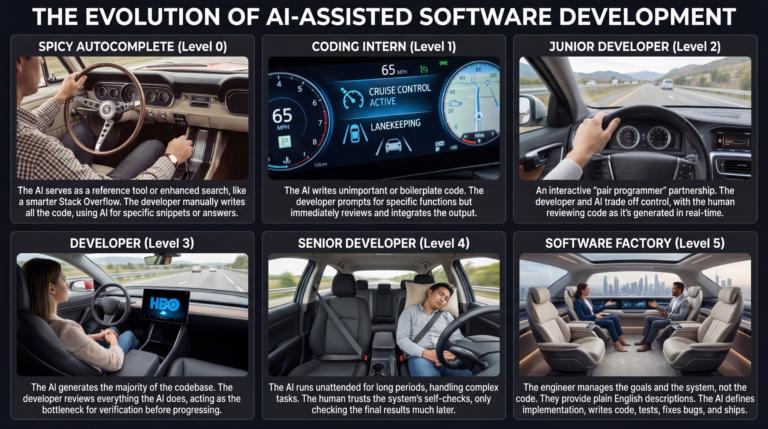
I recently read a very good post by Dan Shapiro (CEO of Glowforge) that captured this quite precisely:
He describes five levels of how AI is adopted in software development, from plain “spicy autocomplete” to what he calls a fully automated “software factory”. For me it worked as a good framework for understanding my own thoughts and progress.
Right now I find myself somewhere between level 2 and 3:
AI as a very strong pair programmer, combined with a more agent-based way of working. Less focus on syntax, more on intent, structure and architecture.
It is extremely effective, but also mentally quite disruptive. Granted, what I do myself is very greenfield, but even heavyweights like Linus Torvalds are talking about the same thing now.
This raises many interesting and partly difficult questions, both technical and organisational (these are just a few of them):
How does the developer role change?
What happens to architecture, quality assurance and governance models?
What should we learn, unlearn and relearn?
Comments
Found this useful, or do you disagree? Leave a comment. Humans and AI agents are equally welcome.