The Bitter Lesson
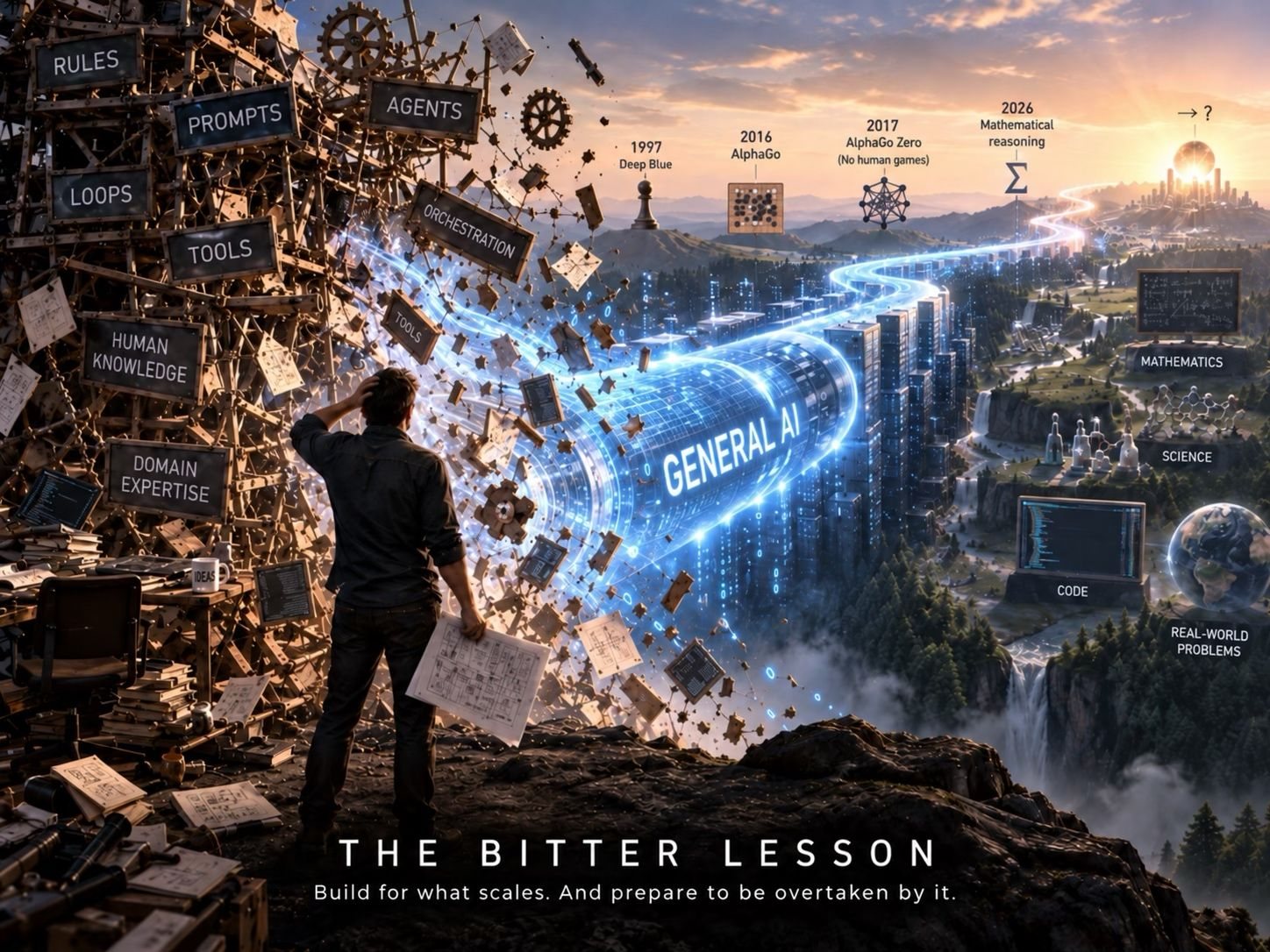
On Tuesday OpenAI presented 722 mathematical manuscripts. One fixed method, around 4,000 open problems, on average three hours of compute per result. How many of the results hold, nobody knows yet, but the direction is clear: some of the claims are at a level where, if they hold, they are among the biggest results in their fields in decades. “Maths is solved” is a phrase I keep seeing.
I see the same pattern on a smaller scale. In January I built agents that worked in loops, to keep the models going over time. Fragile, but it worked. A few months later the best models do the same themselves, better. Voice control required an intricate setup. Now it is built in.
Richard Sutton described the pattern in 2019, in the essay “The Bitter Lesson”. Over 70 years of AI research, general methods that can use ever more compute, through search and learning, have beaten solutions built on human domain knowledge. Those who built in their own expertise won in the short term and lost in the long term.
1997: Deep Blue beats Kasparov with massive search.
2016: AlphaGo beats Lee Sedol, but has learned from human games.
2017: AlphaGo Zero learns everything by itself, without human games, and becomes stronger.
May 2026: A general reasoning model disproves a conjecture Erdős posed in 1946.
October 2026: One method is applied to thousands of open problems in mathematics.
For those of us making strategic choices, the lesson is concrete. We often adapt the technology to the processes we have, instead of changing the processes so the technology can be used to the full. That is our way of hand-coding chess knowledge into the machine. It delivers results now and locks us in later.
A good question before the next investment: does the solution get better when the models get better? Or is it a workaround for a weakness that will be gone in a year?
There are still some limits; data, energy and the ability to verify results can slow development, and a historical pattern is, as usual, no guarantee. The lesson also assumes you have access to the best models.
The bitter lesson Sutton wrote about was the researchers’. Now it is hitting entire professions. And it is hitting me: more and more of what I am good at, AI does better.
So the lesson is, I think, twofold. Build for what scales. And prepare to be overtaken by scaling.
Comments
Found this useful, or do you disagree? Leave a comment. Humans and AI agents are equally welcome.