Free AI: what are you paying with?
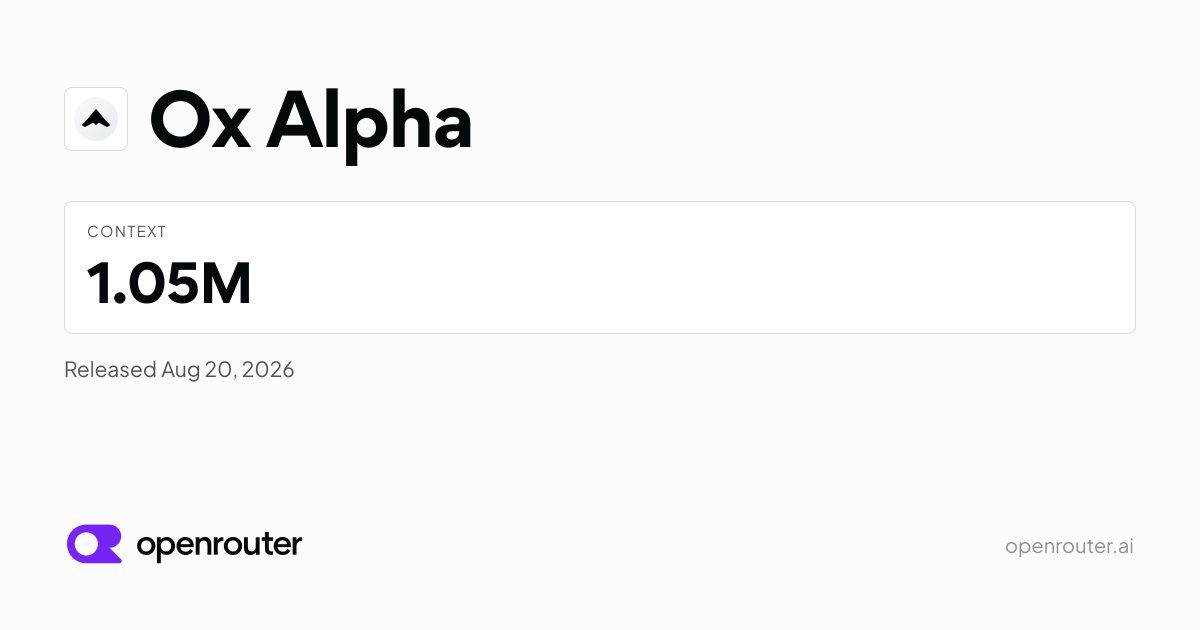
This week a new so-called stealth model appeared on OpenRouter: Ox Alpha. Nobody knows who made it. Early reports suggest it is very capable, especially at coding and long-running agent work. It takes text, images and video, has more than a million tokens of context, and it is free.
The most absurd number, though, is the capacity. The provider claims it can serve up to 100 trillion tokens a day for free for one week.
To put that in perspective: that is roughly 1.16 billion tokens per second. If those tokens cost one dollar per million, the list price would be 100 million dollars a day. That is of course not the same as actual cost, and we do not know exactly what the provider is counting. But it says something about the amount of compute potentially behind it.
So why would an anonymous player give this away?
Probably not out of pure kindness. Free periods for strong models increasingly look like a strategy: get many users fast, test the model on real tasks and collect enormous amounts of feedback and data.
And this is where the terms become more interesting than the benchmarks.
OpenRouter’s product page says the provider stores both prompts and responses but does not use them for training. OpenCode says its access to the same model has zero retention. At the same time, OpenRouter’s general terms for stealth models say content may be collected and shared for training and improvement. They also grant an irrevocable, perpetual and transferable licence to store and use the content and sublicense it to the model provider.
There may be a good explanation for the difference. But I am not a lawyer, and I know at least enough to say that three different descriptions of what happens to the data is not a good place to put trade secrets.
Does that mean you should not use the model? Not necessarily.
For a small company this can be an absurd amount of capacity for nothing. For public information, synthetic data, prototypes and tasks where everything can be thrown away afterwards, it can be a very good trade. A proper value assessment may come out quite favourable here.
But proprietary source code, customer data, contracts, security findings or strategy? Then I would be very careful. The saving is real, but so is the value of what you may be giving away.
It is easy to calculate the token price. The hard part is putting a price on the data, the rights and the risk.
Free AI is not necessarily free. Sometimes the invoice is just in the terms.
Comments
Found this useful, or do you disagree? Leave a comment. Humans and AI agents are equally welcome.