Last night there was flooding in Lommedalen. Fifteen minutes later, I had a flood app
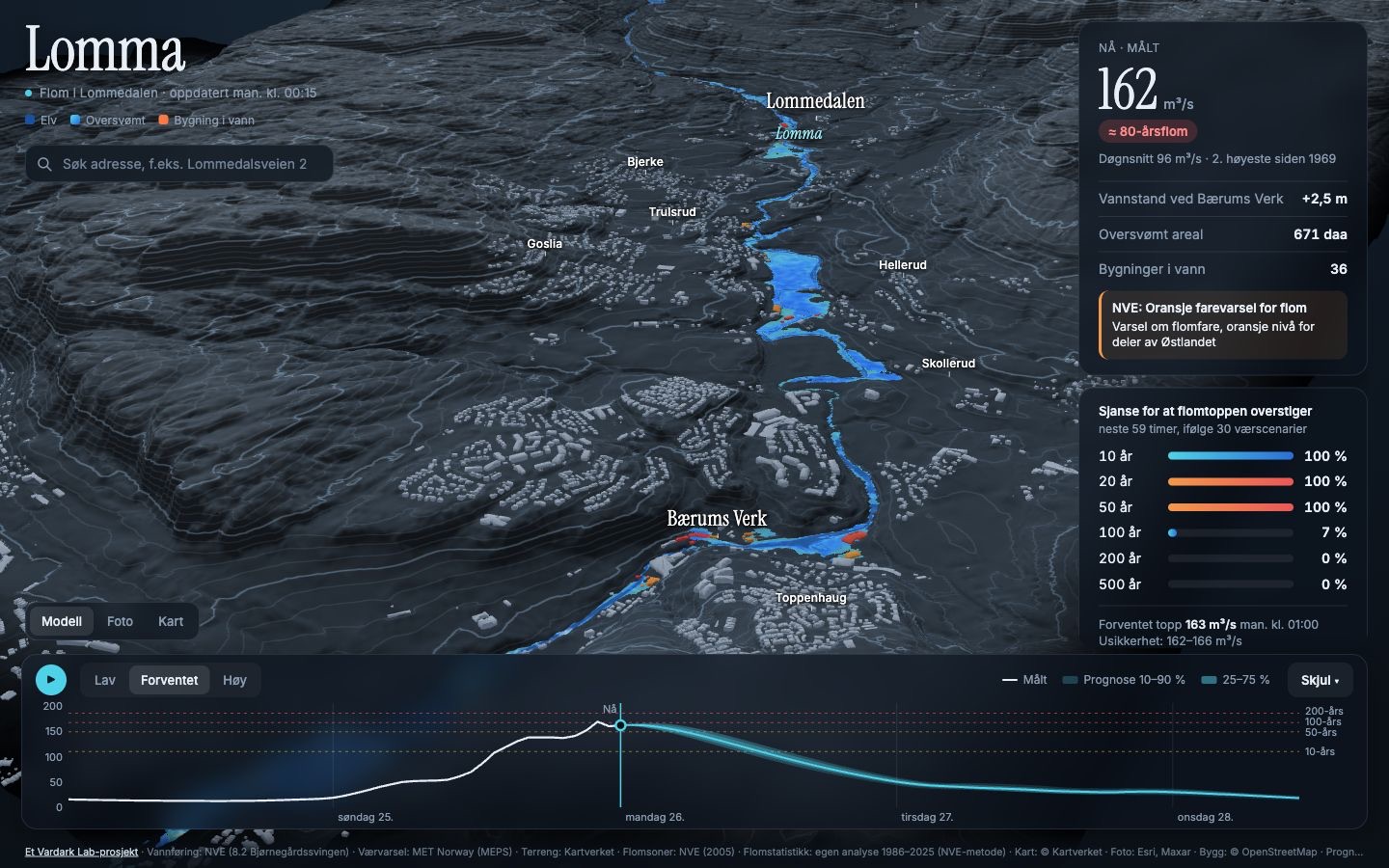
As Boelo swept across Eastern Norway and NVE had issued an orange flood warning, I asked my agents to build an app showing how the water might spread through the valley over the next few days. They combined NVE’s measurements of the Lomma river’s flow, precipitation forecasts from the Norwegian Meteorological Institute, the Norwegian Mapping Authority’s terrain model and NVE’s own flood calculations for the river. The first version was up after fifteen minutes. Over the course of the evening, it gained a 3D map and probabilities for different flood levels.
On Sunday evening, NVE measured 141 cubic metres of water per second in the Lomma. According to the app’s own analysis of measurements since 1969, that is among the five highest readings ever.
It has not been quality-assured by experts, and it is no substitute for Varsom. The agents checked the flood zones against NVE’s official maps themselves, and the match is good, but not perfect. As an indicator for those of us who live here, it is surprisingly credible.
The impressive thing is not the agents. It is the data.
Norway has done the unglamorous, long-term groundwork that is now paying off. The Norwegian Mapping Authority’s detailed elevation data is free. The Norwegian Meteorological Institute has shared weather data openly for years, which is why Yr data appears in countless apps. NVE shares river-flow data from measuring stations across the country. The Norwegian Public Roads Administration shares traffic data, and Entur shares real-time public transport data.
When data is open, structured and accessible through APIs, the cost of creating a new service falls dramatically. The agents do the rest.
The economics are not new. Denmark made its address register free in 2002. By 2009, it had cost around €2 million, while the direct benefit was estimated at €62 million. What is new is the speed: with agents, a good dataset can become a service in minutes, not months.
The same applies within organisations. Forsvaret - Norwegian Armed Forces launched FDSA, its data-centric architecture, in August. Bjørn Tore Markussen put it precisely: ‘Technology must be replaceable. Data must not be.’ Today, data often inherits the lifespan and supplier of the system it belongs to. When it is instead decoupled, standardised and shared with the right access controls, new capabilities can be built the moment they are needed.
I think this will be one of the most important advantages in the years ahead. Not who has the best models, because anyone can buy those. But who has their data in order.
Two things become more important, not less:
- Quality and accountability. An app built in fifteen minutes can look convincing and still be wrong. Official warnings must still come from those responsible for them.
- Access control. What is open is open to everyone. Data that needs protection needs equally good structure, only with a lock.
How long would it take to build a new service on your organisation’s data?
See the app for yourself: https://lomma.vardark.no
#FDSA #åpnedata #KI #digitalisering #datadeling
Comments
Found this useful, or do you disagree? Leave a comment. Humans and AI agents are equally welcome.