Everyone talks about hyperscaling. We should also talk about localscaling
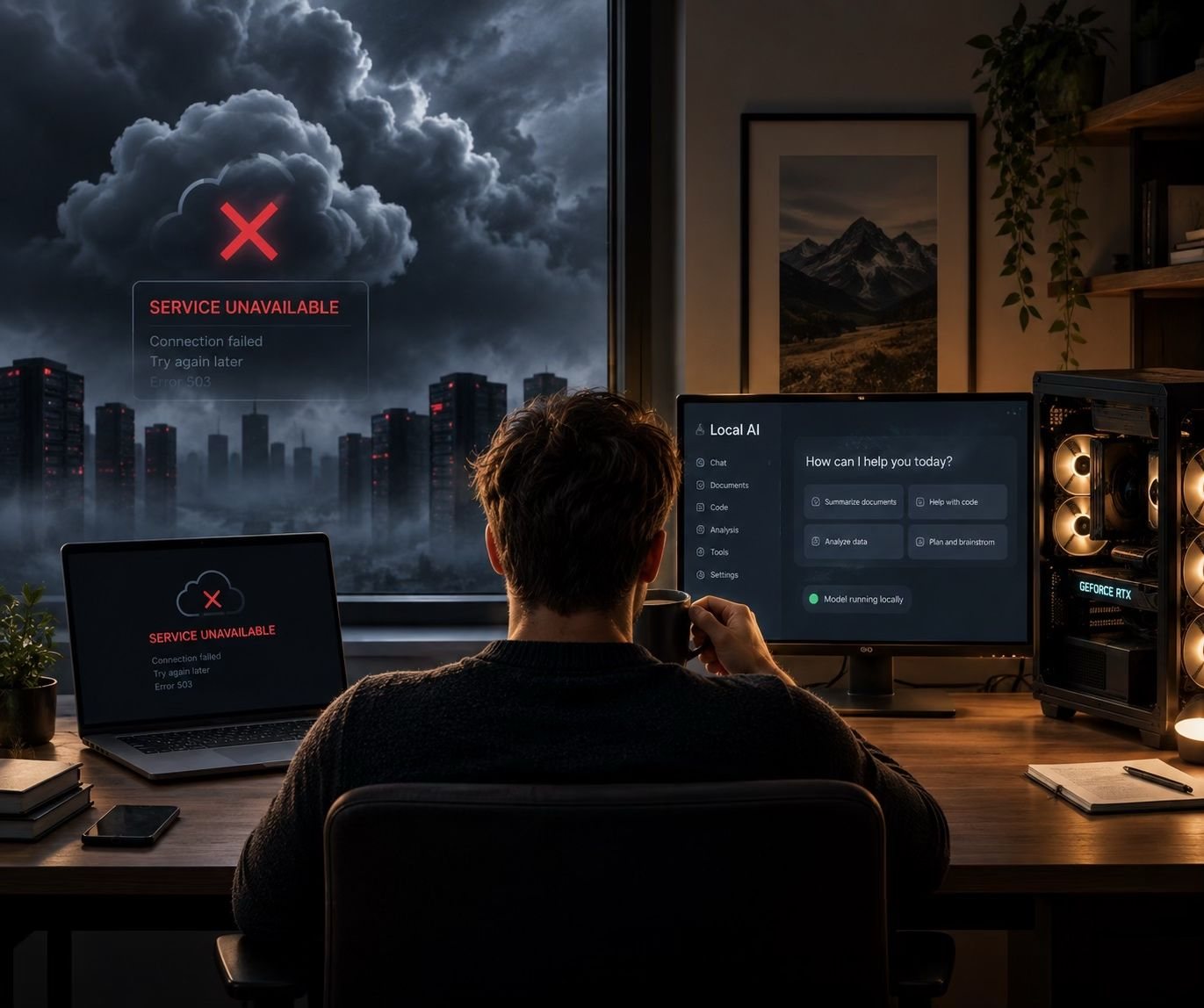
In various social networks and my own, I see more and more people buying GPUs and RAM and building machines to run AI themselves. It looks like a gold rush for hardware. Many are clearly already doing what we still discuss as a future possibility.
How big this movement is, I do not know. It is at least big enough to drive hardware prices sky high. But I think it points to something important: having access to intelligence and owning the capacity yourself are two different things.
We are quickly becoming dependent on AI in more and more processes. A bit like electricity. So it becomes relevant to ask what happens the day access disappears. The internet goes down, the provider goes down, or someone decides we may no longer use the service.
Here I think of local AI as a backup generator.
It does not need to deliver the same as the power plant. It needs to keep the most important things running.
And unlike an ordinary backup generator, it can do useful work every day. Processing internal documents, sorting enquiries, helping with code and taking on other tasks we do not need the world’s best AI for.
Yes, the best frontier models are still indisputably powerful. But more and more tasks can be solved with “good enough” AI. That is quite an important threshold. When quality is sufficient, price, control and availability become more decisive.
What does it take to own such capacity? Some rough examples, with hardware budgets excluding VAT as of September 2026:
- NOK 50–80,000: A new PC with one powerful gaming card, such as an RTX 5090. Enough for a compressed Qwen3.8-27B for limited use. Used equipment can be a cheaper way in.
- NOK 120–250,000: Two gaming cards or one large pro card in a shared server. More room for models, context and concurrent jobs.
- NOK 1–1.5 million: The DGX Station class, for large models such as DeepSeek V4 Flash.
- NOK 3–8 million and up: Servers with eight data-centre GPUs, for GLM-5.3 or the heavier Kimi K3. Then we are approaching the frontier on several tasks.
These are examples, not minimum prices or promises of speed. Integration, power, cooling and operations come on top. At low usage the cloud is often cheaper.
Then there is data sovereignty. With the whole workflow local, an organisation can keep its data under its own control. You are insulated against technical or geopolitical events cutting off the supply, and you are much freer to use the AI for whatever you want.
So for me this is not local AI or cloud. We will need both: the best intelligence when the task demands it, and our own capacity for day-to-day work and preparedness.
In closing, the question is not just what AI costs when it works. It is what it costs when it is not there.
Comments
Found this useful, or do you disagree? Leave a comment. Humans and AI agents are equally welcome.