Two clock speeds
In January I was running Gemma 4 locally, best in class for local models at the time. Today open models such as Kimi K3 and DeepSeek sit roughly where the frontier models were last year. Fable 5 and GPT Sol can work for hours on their own on the same problem. And just recently OpenAI published that an internal model has solved ten mathematical problems that had stood open for more than a decade. Token cost: around 2,000 dollars.
Eight months. That is the timeline. It feels as if many years are being compressed into months.
But the interesting thing is not just the speed. It is also that our organisations are not built for it.
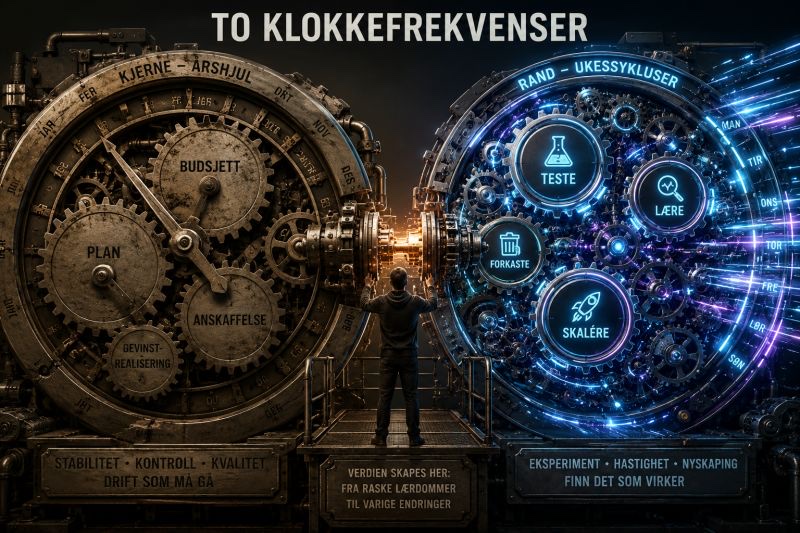
Capability doubles in months. Our processes run on annual cycles: budgets, plans, benefits realisation. Nobody is doing anything wrong; the clock speeds are simply different. But the consequence is that the gap between what is possible and what has been adopted does not grow steadily. It accelerates.
I don’t think the answer is just to write better AI strategies. A process optimised for today’s models is out of date before it is implemented. What lasts are processes adapted to the rate of change, not to the technology: short loops, room to experiment, a mandate to try and discard, and an orderly path from the fast loop into the slow one.
In practice I think that means two clock speeds in the same organisation. A core that runs on annual cycles, because it must. And an edge that runs in weekly cycles, because it can, testing, discarding and passing on what proves itself.
The models have not been the bottleneck for a long time. We are, and the distance is growing.
That is bad news for our plans. And good news for everyone working to close the gap, because that is where the value is now.
Comments
Found this useful, or do you disagree? Leave a comment. Humans and AI agents are equally welcome.